Residential · Openers
Garage Door Opener Repair & Installation in Kansas City
A dead or unreliable opener is one of those problems that turns a normal day sideways — you're already in the car and the door just sits there. We diagnose the real cause, fix what's worth fixing, and handle garage door opener installation when the old one has earned its retirement. Same-day garage door opener repair near you, across the KC metro.
The opener is the part of the door you actually interact with — the button, the remote, the keypad — so when it acts up, it's the most noticeable failure in the whole system. Sometimes it's genuinely the opener: a worn drive gear, a tired logic board, a capacitor that can no longer kick the motor over. Other times the opener is the victim, straining against a door that's out of balance from a spring or cable problem. Telling those apart is half the job.
KC Garage Door Repair handles garage door opener repair every day across the Kansas City metro, from our Olathe shop out through Johnson County and over the state line into Missouri. We track the symptom back to the actual cause instead of throwing parts at it, we'll tell you honestly when a repair makes sense versus when a new unit is the smarter spend, and we install modern openers — Wi-Fi control, keyless entry, battery backup, quiet belt drive — from brands like LiftMaster, Chamberlain, and Genie. When people search for garage opener repair near me, an Olathe-based truck is often already working close by.
Why Openers Quit — And What's Actually Broken
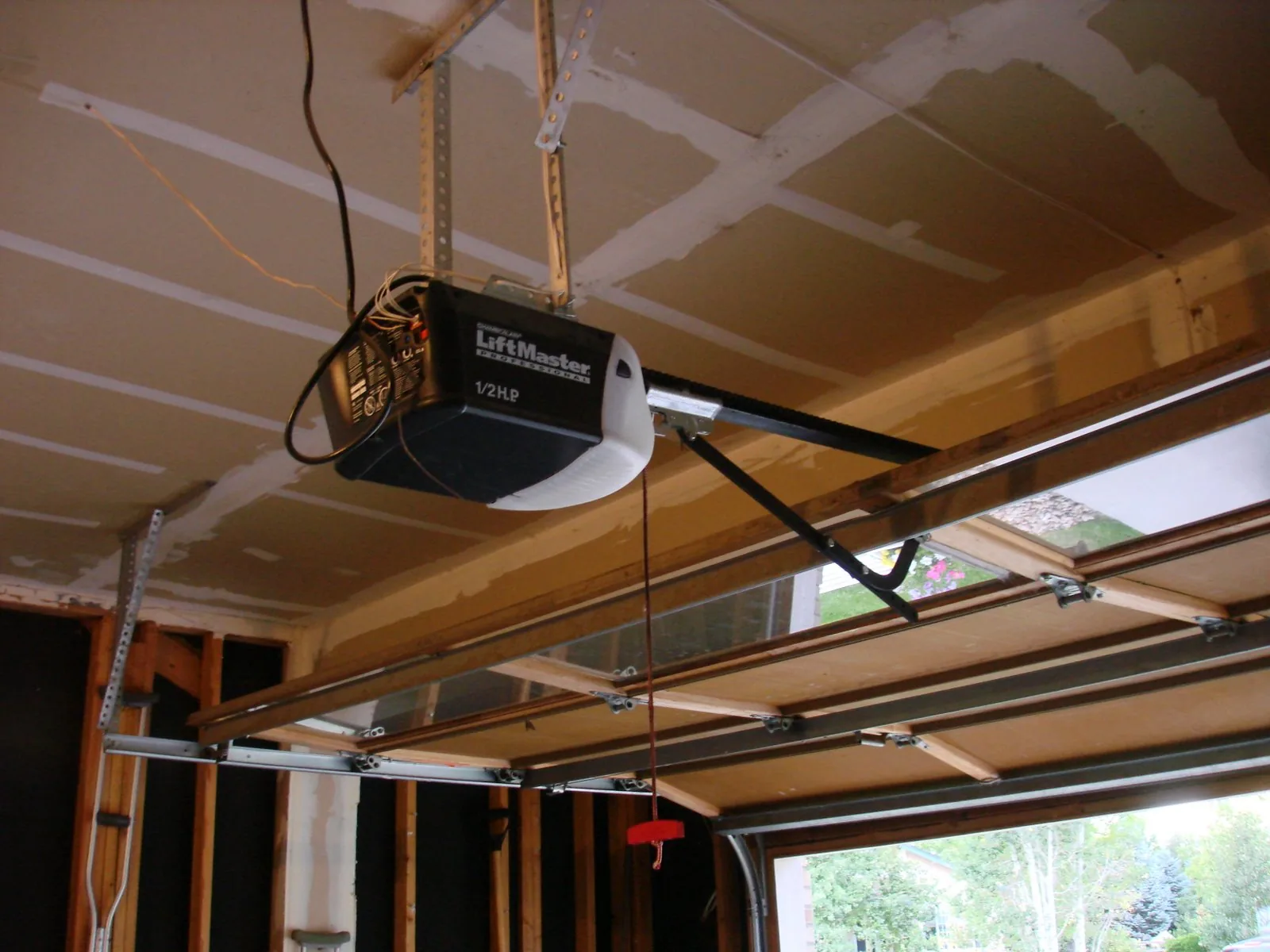
An opener is a small motor, a drive system, a control board, and a pair of safety sensors all depending on each other. When one piece slips, the symptoms can look like something else entirely, which is why guessing gets expensive fast.
The most common failures we see are wear and electronics. Plastic drive gears strip after years of cycles and the motor spins without moving the door. A capacitor weakens and the motor hums but can't start. The logic board takes a power surge and goes unresponsive or erratic. And very often the real culprit isn't the opener at all — it's the safety sensors at the bottom of the tracks knocked out of alignment, so the door refuses to close and reverses every time.
- Stripped or worn drive gear — motor runs, door doesn't move
- Failing capacitor — motor hums but won't start the lift
- Logic / circuit board fault — unresponsive, intermittent, or random behavior
- Misaligned or dirty safety sensors — door won't close or reverses on its own
- Dead or unprogrammed remotes and keypads — usually battery or re-pairing, not the opener
- An unbalanced door overworking the motor — points back to a spring or cable issue

LiftMaster, Chamberlain & the Other Brands We Service
We repair and install garage door openers from LiftMaster, Chamberlain, Genie, and the other major brands you'll find on KC garages. Naming them matters because parts, remotes, and programming differ from one brand to the next — a LiftMaster opener repair isn't the same procedure as a Genie one, and we carry common parts for the units we see most.
We're not a factory or authorized dealer for any single manufacturer, and we won't pretend otherwise. Our job is matching the right, properly sized unit to your door and setting it up safely — whether that means fixing the Chamberlain garage door opener you already have or installing a new one. If your opener brand isn't on the list, ask; we work on most residential units regardless of badge.
- LiftMaster opener repair — gear kits, logic boards, remotes, myQ programming
- Chamberlain garage door opener repair and replacement
- Genie openers and other major residential brands
- Remote, wall-button, and keyless-keypad re-pairing for any brand we service
- Honest, non-dealer advice — we match the unit to your door, not to a sales quota

Chain vs. Belt vs. Screw vs. Wall-Mount — Which Opener Drive Is Right
If you're weighing a new opener, the drive system matters more than any single feature. There are four common types, and the right one depends on your garage layout, your door's weight, and how much noise you can live with. The belt drive vs chain drive opener question is the one we get asked most.
A chain drive is the economical workhorse — durable and fine for a detached garage, but the metal-on-metal chain is the loudest option. A belt drive runs the door on a reinforced rubber belt, which makes it the quietest choice and the one we usually recommend for garages under or beside living space. A screw drive uses a threaded steel rod, has fewer moving parts, and sits in the middle on noise and price. A wall-mount / jackshaft opener mounts on the wall beside the door instead of on the ceiling, which frees up overhead space and suits high-lift, low-headroom, or carriage-style doors.
We'll size the drive to your actual door weight rather than dropping in a one-size motor, and we'll tell you straight which one earns its cost in your garage.
- Chain drive — most economical, loudest; good for detached garages
- Belt drive — quietest, smoothest; best under or next to living space
- Screw drive — fewer parts, moderate noise and cost
- Wall-mount / jackshaft — frees the ceiling, ideal for high-lift or low-headroom doors

Repair It or Replace It — The Honest Call
Plenty of opener problems are a clean, affordable fix. A new gear kit, a remote re-pair, a sensor realignment, a fresh logic board on a unit that's otherwise solid — these are repairs worth making, and we'd rather make them than upsell you a new motor you don't need.
Replacement starts to make sense when the unit is old enough that parts are scarce, when it's a loud chain drive in a bedroom-adjacent garage, when it has no safety reverse, or when the repair cost is creeping toward the price of a far better new opener. Most openers run roughly 10 to 15 years, so a unit pushing the end of that window with a failing board is often a garage door opener replacement rather than a repair. We'll lay out both paths in plain terms and let you decide — there's no script here. If the door itself feels rough, an annual tune-up can buy a tired opener years.
- Worth repairing: gear kits, capacitors, sensors, remotes, many logic boards
- Lean toward replacing: very old units, scarce parts, no safety reverse, repeat failures
- A new opener buys you quieter operation, smartphone control, and current safety features
- We'll quote the repair and a replacement option so the choice is yours, not ours

Smart Openers: Wi-Fi, myQ, Battery Backup & Keyless Entry
If you're due for a new opener, the features available now are a real upgrade over a 15-year-old chain unit. A Wi-Fi garage door opener lets you open, close, and check the door's status from your phone — LiftMaster and Chamberlain build this in through their myQ app, and Security+ rolling-code remotes keep the signal from being copied. We install the conveniences people actually use and skip the gimmicks.
A battery backup opener keeps the door working through a power outage, so a storm that knocks out power doesn't trap your car in the garage. Add keyless entry pads, integrated LED lighting, and current safety sensors, and a modern opener is a genuinely different machine. We're honest about what needs a whole new unit versus what an add-on can do: many newer openers accept a smart add-on controller, while older units are usually better off upgraded outright.
- Wi-Fi / smart control (myQ on LiftMaster and Chamberlain) — open, close, and check status from your phone
- Security+ rolling-code remotes for a signal that can't be copied
- Battery backup that keeps the door working through a power outage
- Keyless entry pads so the family gets in without a remote or key
- Quiet belt-drive systems and bright integrated LED lighting
- Units sized to your door weight, not a one-size-fits-all motor

What Drives the Cost of an Opener Repair or Installation
We don't publish opener prices online, because the honest number depends on what's actually in your garage — and we'd rather quote the real job than bait you with a figure that changes the moment we look at the door. What we can do is explain what moves the price so there are no surprises.
For a repair, it comes down to which part failed — a remote re-pair is a small fix, a logic board or full gear-and-sprocket job is a bigger one. For a new garage door opener installation, the drivers are the drive type you choose (a belt drive costs more than a chain), your door's size and weight (a double door needs more motor than a single), the smart and battery-backup features you add, and the condition of the existing wiring and rail. A straight swap is simpler than a first-time install that needs new wiring run.
Whatever the job, we explain the cause and the options, and you get a clear price for the actual fix before any work starts. We diagnose it on site first. Want a number for your setup? Call (913) 662-3939.
- Repair: which part failed — remote/sensor (small) vs. logic board or gear-and-sprocket (larger)
- Install: drive type chosen — belt drive runs higher than chain
- Door size and weight — a double door needs a stronger motor than a single
- Smart, Wi-Fi, and battery-backup features added
- Condition of existing wiring and rail — a straight swap vs. a first-time install

Safety Sensors — The #1 Thing People Mistake for a Broken Opener
If your door starts to close and then reverses, or won't close at all, the opener is usually fine — the two photo-eye sensors near the floor have lost their alignment or gotten dirty. Those sensors are a federally required safety feature: they stop the door if anything (a pet, a kid, a bike) breaks the beam, and they'll stop it if they simply can't see each other.
A bumped bracket, a cobweb over the lens, or sunlight hitting the eye at the wrong angle is often all it takes. We realign and clean the sensors, confirm the indicator lights are steady, and test the auto-reverse so the door stops and backs off the way it's supposed to. Our full garage door safety guide walks through the same checks.

UL 325 Safety Setup — Force, Travel Limits & Auto-Reverse
Replacing the broken part is only half the job; an opener isn't finished until it's calibrated to operate safely. Every repair and installation we do ends with a code-aware safety setup to the UL 325 standard that governs residential openers, so the door behaves the way the safety system was designed to.
That means setting the open and close travel limits so the door seats fully without straining, calibrating the closing force so the door reverses the instant it meets resistance, and testing the photo-eye sensors and the auto-reverse together. We put a 2x4 under the door and confirm it reverses on contact, then check the beam break. If it doesn't pass, it isn't done — that's the line that separates a working opener from a safe one.
- Set open and close travel limits so the door seats without straining
- Calibrate closing force to reverse the moment it meets resistance
- Test the photo-eye beam and the auto-reverse on contact (UL 325)
- Confirm steady sensor indicator lights before we leave
Commercial & Heavy-Duty Opener Operators
Openers aren't only a residential job. We also service commercial and heavy-duty operators for shops, warehouses, and multi-bay facilities across the metro — the jackshaft and trolley operators and commercial logic boards that run far heavier doors than a home unit ever sees.
A down commercial door is a security and downtime problem, so the diagnosis and parts are different, but the approach is the same: find the real cause, fix what's worth fixing, and get the bay moving again. See our commercial spring and opener repair for the full scope.
- Jackshaft and trolley commercial operators
- Commercial logic boards, gears, and control wiring
- Multi-bay shops, warehouses, and facilities across the KC metro
- Same diagnose-first approach, sized for heavier doors

What We Service
We handle the whole opener, not just the box on the ceiling. A lot of "my opener is broken" calls turn out to be a quick fix once we trace the symptom, and we'd rather find that than charge you for a new motor.
- Diagnose unresponsive, intermittent, or erratic openers
- Replace drive gears, capacitors, and faulty logic boards
- Quiet down noisy chain drives or swap to a belt-drive unit
- Realign and clean safety sensors; test the auto-reverse to UL 325
- Reprogram remotes, wall buttons, and keyless entry pads
- Install new openers with Wi-Fi, battery backup, and current safety features

Garage Door Opener Repair Near You — Across the KC Metro
We run garage door opener installation and repair out of our Olathe shop and cover the whole Kansas City metro on both sides of the state line — Johnson and Wyandotte counties in Kansas, Jackson, Clay, Platte, and Cass counties in Missouri. When you search for garage door opener repair near me, that's the footprint a truck is dispatched from, and one is often already working close by.
We're in Overland Park, Lenexa, Shawnee, and Leawood daily, out to Lee's Summit, Independence, and Liberty across the line, and through the smaller towns in between. Same-day service is the norm for openers because most common parts ride on the truck. The cities below have a dedicated page with the local detail.

Stronghold Coverage — Where We Run This Repair Most
These are the cities where we run garage door opener repair the most — the Overland Park / Leawood stronghold and the surrounding core of Johnson County we cover daily from our Olathe shop. Each city has a dedicated page with the honest detail on what the failure looks like there, what we bring, and how the repair finishes:
- Opener Repair in Overland Park, KS — same-day from Olathe, common parts on the truck, fully re-balanced before we leave.
- Opener Repair in Leawood, KS — same-day from Olathe, common parts on the truck, fully re-balanced before we leave.
- Opener Repair in Lenexa, KS — same-day from Olathe, common parts on the truck, fully re-balanced before we leave.
- Opener Repair in Shawnee, KS — same-day from Olathe, common parts on the truck, fully re-balanced before we leave.
- Opener Repair in Olathe, KS — same-day from Olathe, common parts on the truck, fully re-balanced before we leave.
Warning Signs
Signs Your Opener Needs Attention
- You press the button or remote and nothing happens at all
- The motor runs or hums but the door doesn't move
- The door starts to close, then reverses back up on its own
- The opener works sometimes and ignores you other times
- Loud grinding, rattling, or chain-slap when the door runs
- Remotes or the keypad have stopped working out of nowhere
Our Process
How We Handle an Opener Problem
Call or Book
Describe what the opener is doing — dead, noisy, intermittent. Call/text (913) 662-3939 or book online.
We Diagnose
A technician tests the motor, board, sensors, and door balance to find the real cause, not just the symptom.
Repair or Replace
We fix what's worth fixing or, if it's smarter, install a properly sized new opener — your call, clearly explained.
Program & Test
We program your remotes and keypad, set the travel and force, and confirm the safety reverse works to UL 325 before we leave.
Related Services
You Might Also Need
LiftMaster Opener Service
Independent service for every LiftMaster residential model.
Learn moreChamberlain Opener Service
Service for the Chamberlain residential opener line.
Learn moreGenie Opener Service
Including older Genie screw-drive units.
Learn moreMyQ & Smart Openers
What MyQ does, pairing problems, the Genie equivalent.
Learn moreGarage Door Spring Repair
Broken torsion & extension springs, replaced safely.
Learn moreTune-Up & Maintenance
Lube, balance, hardware & safety-sensor service.
Learn moreNew Door Installation
New residential garage doors, supplied and installed.
Learn moreBrands We Service
Every common residential and commercial brand.
Learn moreSprings, Cables & Operators
Commercial springs, cables and door operators.
Learn moreFAQ
Opener Repair & Install — Common Questions
My opener runs but the door won't move — what's wrong?
Usually it's a stripped drive gear inside the unit: the motor spins freely but no longer grips the drive. It can also be a broken trolley or, if the door feels very heavy, a balance problem from a spring or cable. We'll confirm which it is on site and tell you whether a gear kit or a different repair is the fix. Call (913) 662-3939.
Should I repair my opener or replace it?
If the unit is reasonably modern and the problem is a single part — a gear, a capacitor, a board, a remote — repair is usually the better value. If it's old, parts are getting scarce, it's a loud chain drive, or it lacks safety reverse, a new opener is often the smarter spend. We'll quote both so the decision is yours.
Why does my garage door reverse before it closes?
Nine times out of ten it's the safety sensors near the floor — they're out of alignment, dirty, or getting hit by direct sunlight, so the opener thinks something is in the way and backs off. It's a quick realign-and-test for us, and it's almost never the opener itself. Don't bypass the sensors to force it closed.
Do you repair and install LiftMaster and Chamberlain openers?
Yes — we repair and install LiftMaster, Chamberlain, Genie, and other major opener brands. We're honest that we're not a factory or authorized dealer for any single brand; our job is matching the right unit to your door and setting it up safely, whichever brand it is. Tell us what you have and we'll let you know the parts and options.
How much does it cost to install a new garage door opener?
We don't publish a flat price, because the honest number depends on your setup: the drive type you choose (a belt drive costs more than a chain), your door's size and weight (single vs. double), the smart and battery-backup features you add, and whether it's a straight swap or a first-time install needing new wiring or rail. We quote the exact job on site — We diagnose on site. Call (913) 662-3939 for a number on your garage.
Is a belt-drive opener really quieter than a chain drive?
Yes — a belt drive runs noticeably quieter than a chain drive, which is why it's our usual recommendation for garages under or beside living space. A chain drive is more economical and perfectly fine for a detached garage. If you're upgrading, we'll match the drive to your door and your noise tolerance.
How long does it take to install a garage door opener?
Most standard residential installs are finished in a single same-day visit. It runs longer when we have to add wiring, mount a wall-mount or jackshaft unit, or set up smart accessories — but the goal is to leave your door working that day. We cover the whole KC metro same-day, so scheduling is rarely the holdup.
Can I add Wi-Fi or smartphone control to my existing opener?
Sometimes. Many newer openers can take an add-on smart controller (a myQ-type module) that gives you app control without a new unit. Older openers are usually better off upgraded to a new Wi-Fi opener. Tell us your current model and we'll tell you the best route rather than promise compatibility sight-unseen.
Is battery backup required on a new garage door opener?
It's required by code on new residential openers in some states, and it's worth having everywhere so the door still opens during a power outage. We'll tell you whether it's required for your install and fit a battery backup opener if you want one — it means a storm that kills your power doesn't trap your car in the garage.
How long should a garage door opener last?
Most openers run roughly 10 to 15 years with normal use and basic maintenance. Drive type, how many cycles the door sees, and whether the door stays balanced all affect it — an opener fighting a heavy, out-of-balance door wears out early. If yours is near the end of that window and acting up, an annual tune-up or a replacement is usually a better bet than a third repair.
Online Booking
Book Your Garage Door Service Online
Pick a time that works for you — residential or commercial. Prefer to talk it through? Call or text (913) 662-3939 for same-day and emergency service.